
Ad Astra
Special Relativity simulation (javascript with WebGL) with interstellar travel. It's a standalone 13MB javascript file that will run in your browser.
The star catalogue has about 140k entries, it should cover all of HIP plus some selected nearby or bright stars from GAIA3. Solar system objects should be represented down to about 300km diameter (excluding transneptunian objects). Solar system bodies have their own temperatures with infrared radiation becoming visible at sufficient blueshift. Earth in particular has water and ice detection to model their reflective properties, otherwise bodies just have a fixed albedo reflecting their star's light. There are also some exoplanetary systems (stars with planets are marked in map mode if "Orbits" is enabled).
Here is a lightweight javascript prototype that simulates a "stellar flyby" with proper calculation of the visible spectrum (and representation in rgb) based on Planck radiation (this was turned into a mere lookup table for the main simulation): relativistic_flyby_starfield.html.
repository: github.com/deuterotheodore/adastra
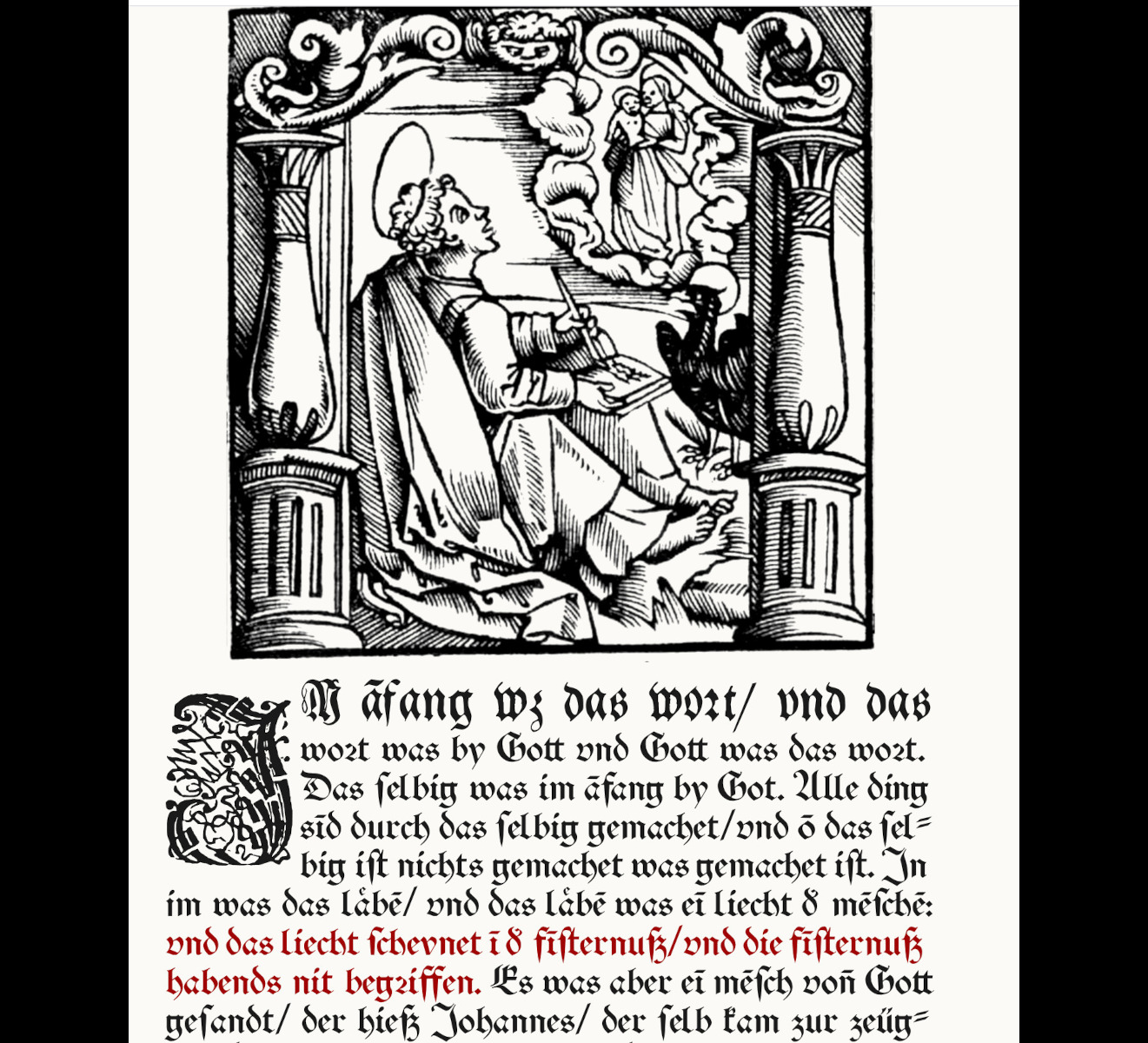
Froschauer-Bibel
Eine Online-Ausgabe der Froschauer-Bibel (Zürcher Bibel) von 1531. Dynamischer Schriftsatz in Schwabacher Schrift: froschauer-1531.ch

Electromagnetic sandbox
A browser-based sandbox for classical electromagnetism: a small number of point charges, their fields drawn as integral curves, and optional dynamics with finite signal speed. Single HTML file, imports three.js. The design premise is particle superposition, not field discretization: "Liénard–Wiechert with Purcell kinks", fields are evaluated in closed form at whatever points the renderer happens to need.

LXX
Javascipt browser for Rahlfs' 1935 edition of the Septuagint, with Greek concordance and aligned Hebrew text. This is a standalone 12MB file running in the browser (also works offline).
Most online Bible browsers are Hebrew-centric, and it is hard to find a concordance of the Greek OT, or to match the Greek to the Hebrew text (it's mostly Hebrew-to-KJV). This provides a concordance of the Greek OT, and there is also a heuristic alignment of the Greek text to the Hebrew (this may fail when the differences are substantial).
The text of Rahlfs is from wikisource, but it has been checked against CATSS, with a small number of typos corrected. We do not have a digitization of the critical apparatus, but the text has been matched to Swete's LXX (after verse alignment), which is mostly a diplomatic edition of Codex Vaticanus, and differences between Rahlfs and Swete are shown. There is also Greek lemmatization and morphological analysis, in part due to Project Perseus' "Morpheus", and Hebrew lemmatization, entirely due to Open Scriptures (via HELFI).
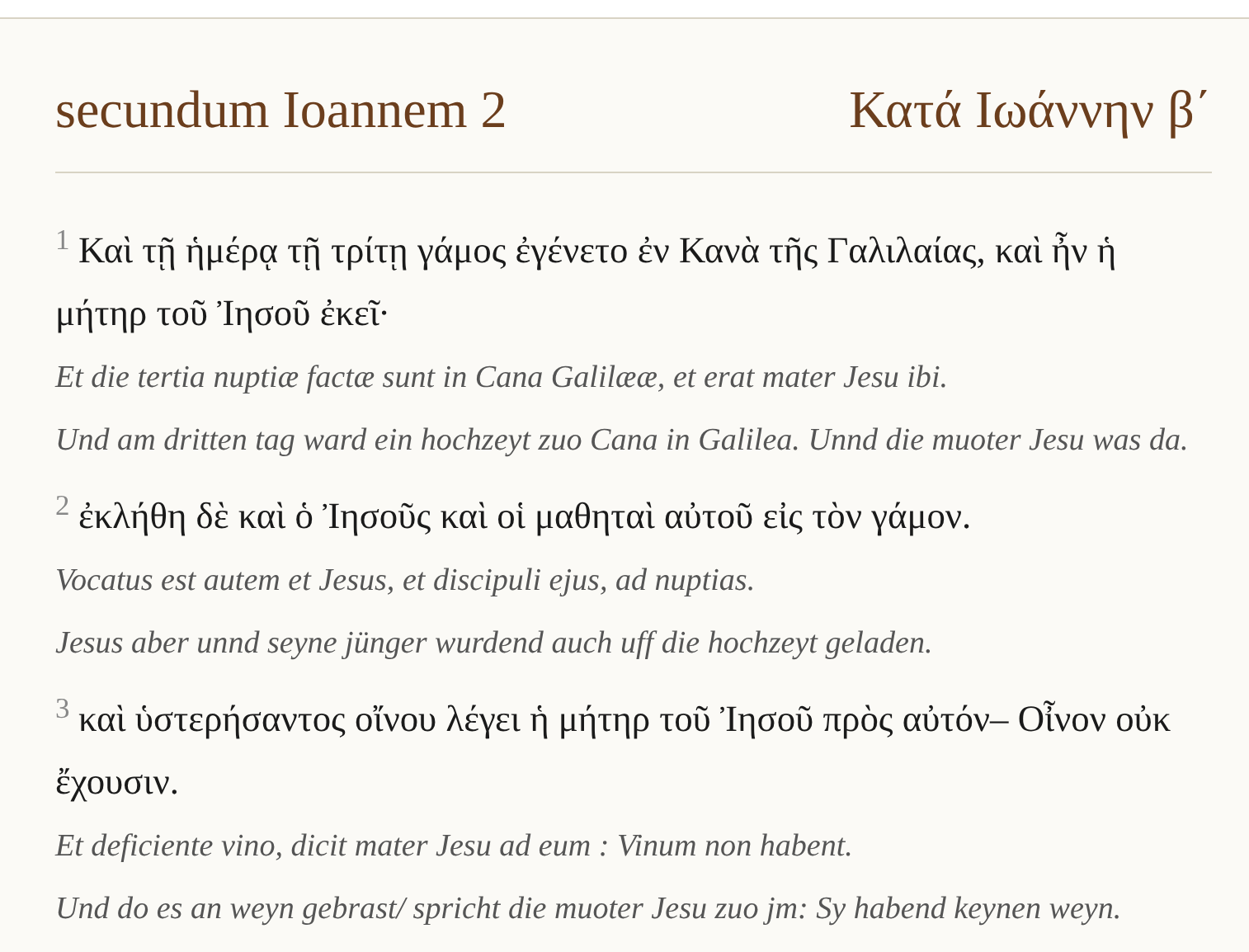
NT
Javascipt browser for the Greek New Testament. This is a standalone 3MB file running in the browser (also works offline).
This includes the Nestle 1904 text as baseline, with variants shown for numerous other editions, it also has a concordance with lemmatization and grammatical analysis, as well as a few tranlations: currently the Vulgata, Zwingli (Froschauer 1531), Church Slavonic (1751) and KJV (1769).

Unsitjands Saggws
A Gothic translation of the Akathist to the Theotokos:
Unsitjands Saggws Frumaweihái Guþbairandein (pdf).
Edition of the Greek and Slavic text with references:
Ο ΑΚΑΘΙΣΤΟΣ ΥΜΝΟΣ ΕΙΣ ΤΗΝ ΥΠΕΡΑΓΙΑΝ ΘΕΟΤΟΚΟΝ (pdf).
|
Harjawaldái sigins gabeins, / harduharjandein Galausidái us agisa / awiliuda atbairam, Þus Guþbairandein, / þiuda þeina writandans, Ak þu swe habandei / mahts ungajiukida, Alláim sleiþom fralet uns / ei hropjáima þus: Hails, Brūþs Ungawadjoda! |
𐌷𐌰𐍂𐌾𐌰𐍅𐌰𐌻𐌳𐌰𐌹 𐍃𐌹𐌲𐌹𐌽𐍃 𐌲𐌰𐌱𐌴𐌹𐌽𐍃 𐌷𐌰𐍂𐌳𐌿𐌷𐌰𐍂𐌾𐌰𐌽𐌳𐌴𐌹𐌽 𐌲𐌰𐌻𐌰𐌿𐍃𐌹𐌳𐌰𐌹 𐌿𐍃 𐌰𐌲𐌹𐍃𐌰 𐌰𐍅𐌹𐌻𐌹𐌿𐌳𐌰 𐌰𐍄𐌱𐌰𐌹𐍂𐌰𐌼 𐌸𐌿𐍃 𐌲𐌿𐌸𐌱𐌰𐌹𐍂𐌰𐌽𐌳𐌴𐌹𐌽 𐌸𐌹𐌿𐌳𐌰 𐌸𐌴𐌹𐌽𐌰 𐍅𐍂𐌹𐍄𐌰𐌽𐌳𐌰𐌽𐍃 𐌰𐌺 𐌸𐌿 𐍃𐍅𐌴 𐌷𐌰𐌱𐌰𐌽𐌳𐌴𐌹 𐌼𐌰𐌷𐍄𐍃 𐌿𐌽𐌲𐌰𐌾𐌹𐌿𐌺𐌹𐌳𐌰 𐌰𐌻𐌻𐌰𐌹𐌼 𐍃𐌻𐌴𐌹𐌸𐍉𐌼 𐍆𐍂𐌰𐌻𐌴𐍄 𐌿𐌽𐍃 𐌴𐌹 𐌷𐍂𐍉𐍀𐌾𐌰𐌹𐌼𐌰 𐌸𐌿𐍃· 𐌷𐌰𐌹𐌻𐍃 𐌱𐍂𐌿𐌸𐍃 𐌿𐌽𐌲𐌰𐍅𐌰𐌳𐌾𐍉𐌳𐌰: |

Black Hole Sim

The Humanity
This is the current iteration of the Prisoner's Dilemma evolutionary agentic simulation. It now aspires to model the human condition as accurately as, well, humanly possible. Hence the project name, τὰ ἀνθρώπινα.
It uses the client-server approach tested in the Predator-Prey simulation, the server running in python, the client in javascript. Prisoners' Dilemma strategy is now downstream of the "Big Five" personality types, openness, conscientiousness, extraversion, agreeability, neuroticism, which are genes propagated by sexual procreation. Agents have biographies, familial relations and mental states (short-term happiness and longer-term "world-trust"). They have cultural-linguistic and racial-ethnic identities, and genes modifying their ingroup/outgroup behavior based on cultural, genetic and tribal similarity.
The aim here would be to simulate thousands of years of evolution on populations of thousands or tens of thousands of individuals. So there is a tradeoff between simulation complexity and simulation scope. I can currently run this on a laptop in a reasonable timeframe for a couple of centuries and a couple of thousand individuals, but there is potential for optimization.

Predator-Prey
This simple predator-prey simulation was the prototype for a server-client architecture for agentic simulations. The simulation is running in python the visualization and user interface is running in javascript in a web browser. This has the advantage that the simulation can run on its own on a server somewhere, unsupervised, and you just fire up the client when you want to see how it is doing.
In spite of being just a prototype for the architecture, this simulation has its own charm. Predators and prey have vision and speed, vision determines the distance to which they may spot prey or threats, speed determines their chase or flight speed, but cost on speed is quadratic, so there is a precarious balance of having just enough vision and junst enough speed. Prey also have intra-species aggression, so even after predators die out, prey can split into tribes or subspecies that compete for territory.

The Harshest Mistress
The idea was: Prisoner's Dilemma competition, but with evolving strategies. Watch altruism and loyalty emerge from the law of the jungle.
This prototype is running entirely in python (using pygame). It does have quite some bells and whistles, optional sexual reproduction and elaborate sexual selection mechanics, as well as cultural and tribal ingroup/outgroup behaviour.
But it had to be redone from scratch, because the Prisoner's Dilemma strategy encoding was just too smart for its own good, and thus evolutionarily unstable (with reasonable strategies hidden in a sea of nonsensical ones in evolutionary topology).


